
Harmony with nature, part 3
'Copy, comprehend, and cooperate with nature's creative motions.'

What happened near the end of Viktor Schauberger’s life definitely wasn’t as harmonious as his early years. During the final stage of World War II, he may have wished he’d remained a forester and hadn’t invented an energy generator.
I’ve already written about Schauberger’s insights briefly. As a young man he was caretaker of a vast forest where he learned about nature’s ways. Such as using an inward-spiraling vortexean motion in liquids or air, to create a cooling, levitating, energizing force.
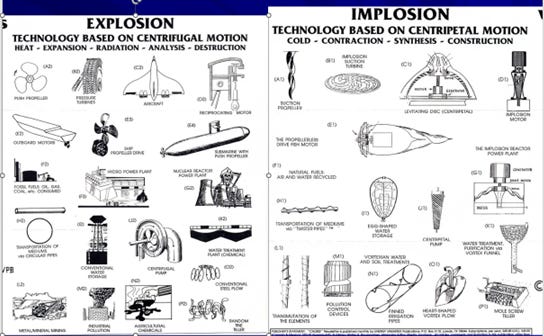
That condensing, cooling inward-spiraling force is less visible than expanding explosive forces.
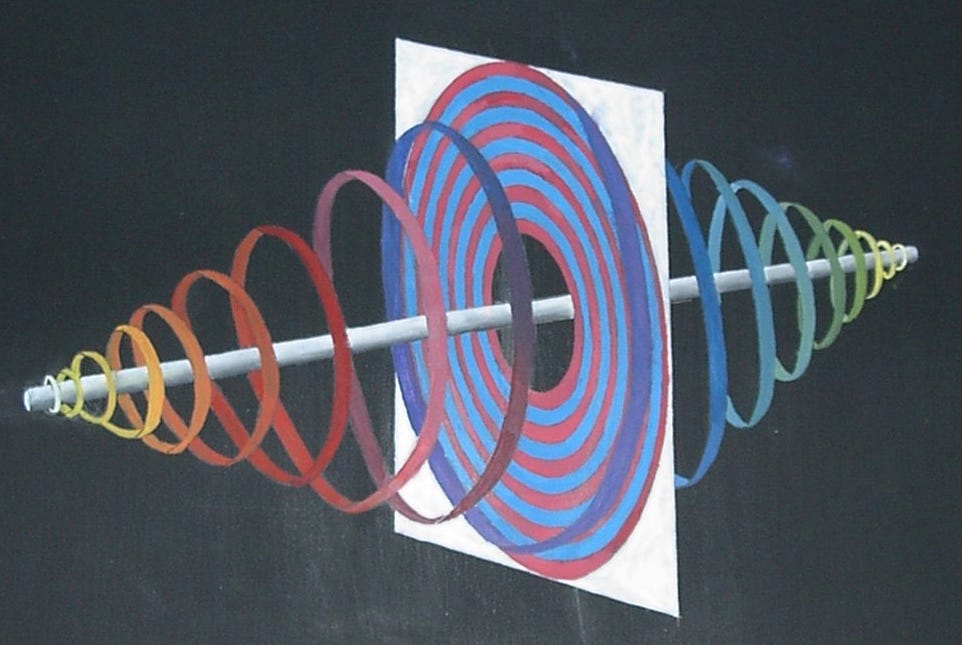
Schauberger deeply observed causes and effects in nature—from the swirling of water in rivers to its effect on riverbank vegetation, and how temperature changes in mountain springs affect water’s ability to carry a load.
He even noted that a egg shape has benefits and could be useful in machines.
Suction, not pressure
Although his heart was with the forest, he must’ve been born with an engineer’s mind.
He designed a log flume that worked because of the natural powers of vortexian motion and cold water’s vitality, and he invented “bio-technologies.”
His inventions didn’t work by pushing water or air. Instead, suction was the principle used for his implosion-based devices.
The experimental devices created a vacuum which sucked in more air or water to be further guided into a vortexian flow, faster and faster as the air or water tightened into density. And increased in power.
Schauberger was middle-aged in 1938 when German troops marched into his country, Austria. They forcibly established a Nazi government.
The war churned onward for seven more years, but Viktor didn’t stop trying to develop harmonious solutions to replace polluting technologies.
In 1939 he filed a patent for a “multi-stage centrifuge with concentrically juxtaposed pressure chambers,” as a means of propelling machines through air or water, purifying water, or generating electricity.
What would you have done?
Toward the end of WW2, Schauberger received orders to report for active duty in the German army.
He was taken to a concentration camp and ordered to pick a team of engineers from among the prisoners to help finish developing his energy device.
The person issuing orders at the concentration camp informed him that he would be killed and his family harmed if he didn’t cooperate.
Schauberger naturally chose to protect his family, and stay alive.
So he and his forced-labor team built a saucer-shaped machine. He insisted that the prisoners be taken away from the concentration camp and into nearby workshops, clothed for the weather, and properly fed.
The machine they were ordered to make was intended to generate useful power and perhaps lift off and fly. One model of it did levitate, violently, and crashed against a ceiling.
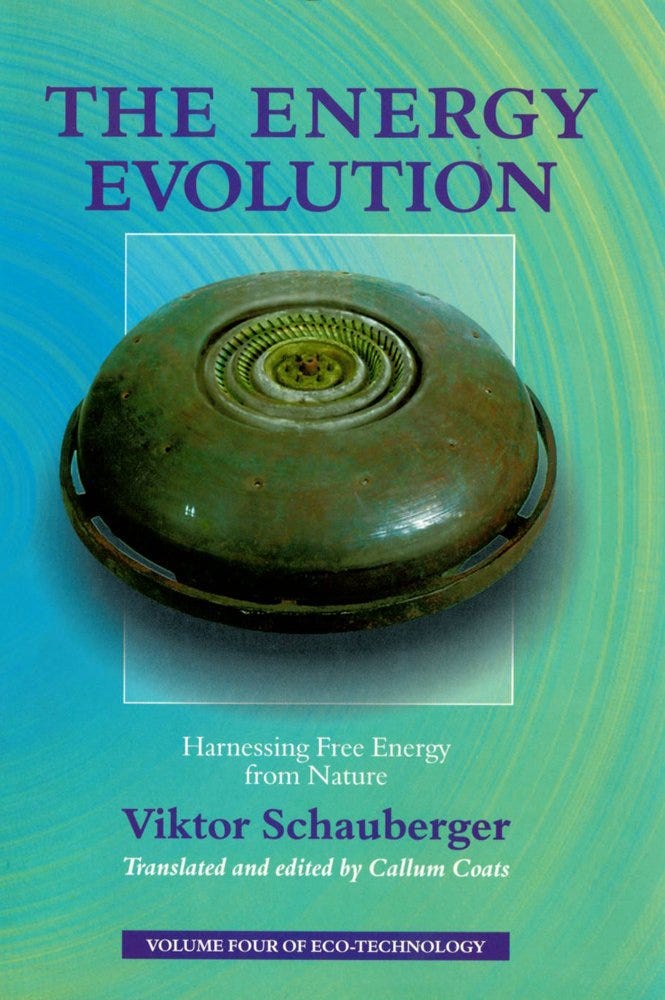
The war ended before his “Repulsine” could be manufactured. A small model maybe two feet in diameter is pictured on Callum Coats’ book cover.
Nick Cook, a distinguished aerospace journalist, gave 20 pages of his book The Hunt for Zero Point to the Schauberger saga. Cook had special access to papers including Viktor’s diary.
As Cook reported, Schauberger’s diary revealed that final assembly of the Repulsine began on 5 April 1945, and a month later the device was “ready to go.”
“But the end, when it came, was almost surreal. Instead of firing up the disc for its first test-run as planned on 6 May, Schauberger awoke to find that the SS officers charged with oversight of the operation had fled into the night. The team stopped work on 8 May, hours before the surrender of German forces took effect…”
“The diary had made it clear that Viktor Schauberger had built a machine that had flown earlier in the war… It was also quite clear that the device’s modus operandi was wholly unconventional—that is to say, the method by which it generated lift was insufficiently explained by current scientific knowledge.”
U.S. intelligence agents later found and apprehended Schauberger. At almost the same moment, miles away, Russian intelligence agents broke into his apartment in Vienna. Cook reports they removed anything valuable, then blew up the place.
Other authors add that Viktor was later taken to the USA believing that his invention would finally be made available to people.
Instead he returned home heartbroken, one biographer said, because he had lost control of his intellectual property. Viktor Schauberger died soon after.
There’s so much more to tell; it required more than one book. Australian architect Callum Coats wrote a series of at least seven books about Schauberger’s eco-technologies.
Energy generator how-to is still hidden.
The late William Baumgartner and other engineers tell me that, of all of Schauberger’s inventions, the energy generator has been the one most difficult to reproduce.
However, Baumgartner built a model of something that very efficiently and quickly heated water.
Although Viktor Schauberger’s attempts to give us life-enhancing technologies ended sadly, they had begun because he witnessed an antigravity force in action, throughout a pristine forest.
For example, he saw a lake revitalize itself with a large waterspout, fish levitate up a waterfall, sap rise in trees, and water flow vigorously from a mountain spring. He wanted to understand the physics of it all.
Those wonders involved spiraling motion, vortices.
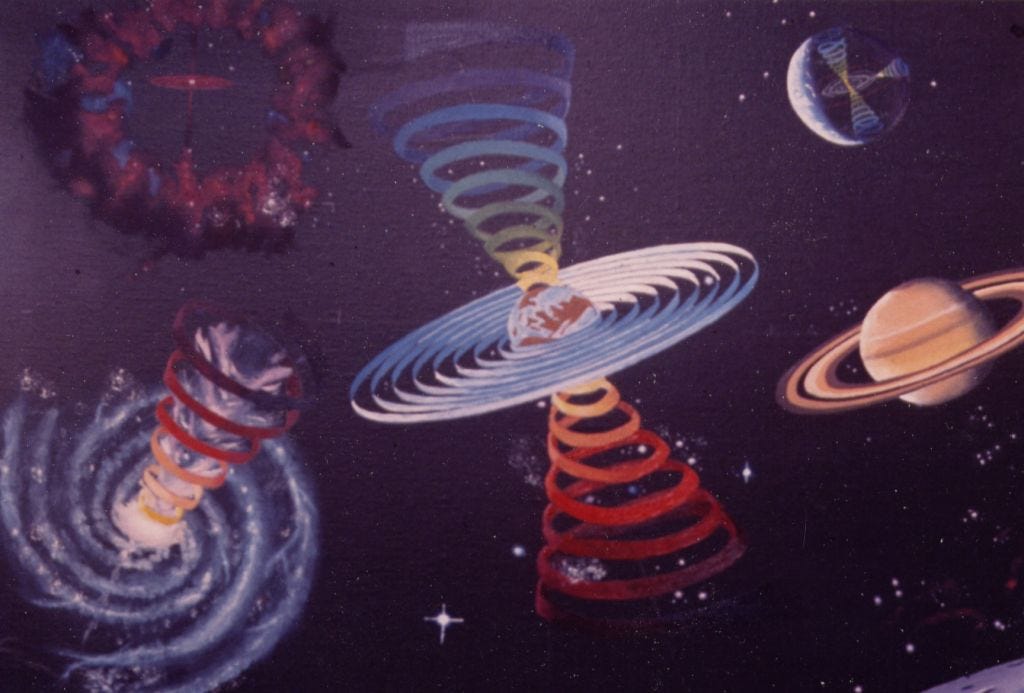
The quest for knowledge and harmony lives on.
To keep Viktor’s legacy alive, his family created beauty—in the architecture of a museum they established and in the harmony-with-nature concepts taught at their Pythagorus-Kepler School.
His son Walter Schauberger’s mind was inclined toward mathematics.
I met Viktor’s grandson, Joerg Schauberger, when we were speakers at a conference in Berlin. He has the skills to communicate the big picture even to non-technical people.
Joerg contributed a third call-to-action to his grandfather’s advice to “Comprehend and copy” nature.
Joerg added “And cooperate with nature.”
Thanks for this interesting piece!!!
Fascinating article. Thank you so much. I had no idea he was forced to work under the Nazi regime.