
Breakthrough-energy seekers need the underlying science
And new fundamental discoveries need a level ‘playing field.’

Gerald H. Pollack, PhD, is a retired bioengineering professor in Seattle who has benefited our world greatly–for example, by inspiring students at the University of Washington, writing books, and organizing water conferences in Europe.
I’ve been a fan of Dr. Pollack’s work ever since he concluded a talk at a large university with “What we like the most is understanding the gentle beauty of nature.”
Oh, and he also founded a nonprofit Institute for Venture Science (IVS) to support breakthroughs.
The institute’s job is to nurture revolutions in basic science, not to fund technology. I’ll get back to the IVS after the following:
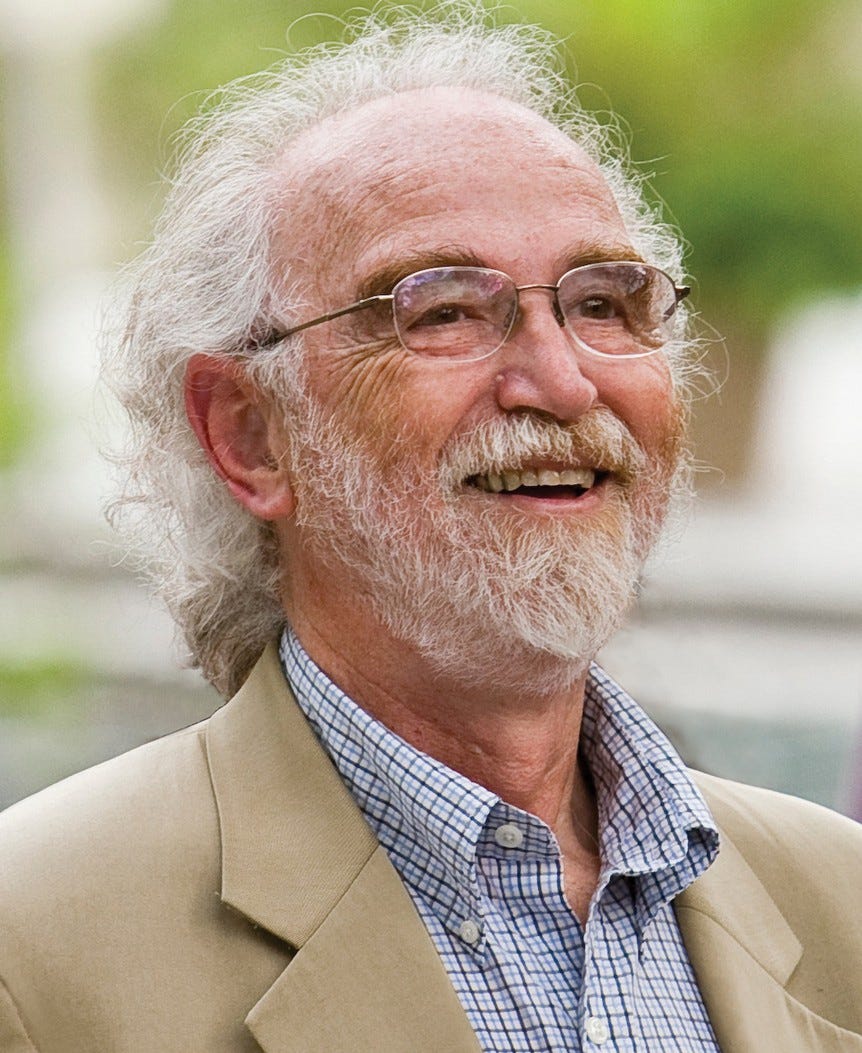
Dr. Pollack’s productive career has been sidelined for now. As I mentioned in December, he suffered a serious stroke at the end of summer.
One of his sons, Ethan Pollack, replied to my recent request for an update.
“My Dad is doing well, improving. His motor skills are coming back, but communication is difficult. He has a great group of therapists and doctors, and is supported by a large network of family, friends and colleagues.”
Ethan is an artist whose playful drawings illustrate concepts in his father’s recent books:
-The Fourth Phase of Water revealed a life-enhancing phase of water, which the scientists named EZ water. It has implications ranging from biology to energy and information storage, and even getting electricity from water.
-Last year, Gerry Pollack published his fascinating new book, Charged: The Unexpected Role of Electricity in the Workings of Nature. (I miss-spelled the title in my December substack post.) His delight in nature’s ways permeates the book.
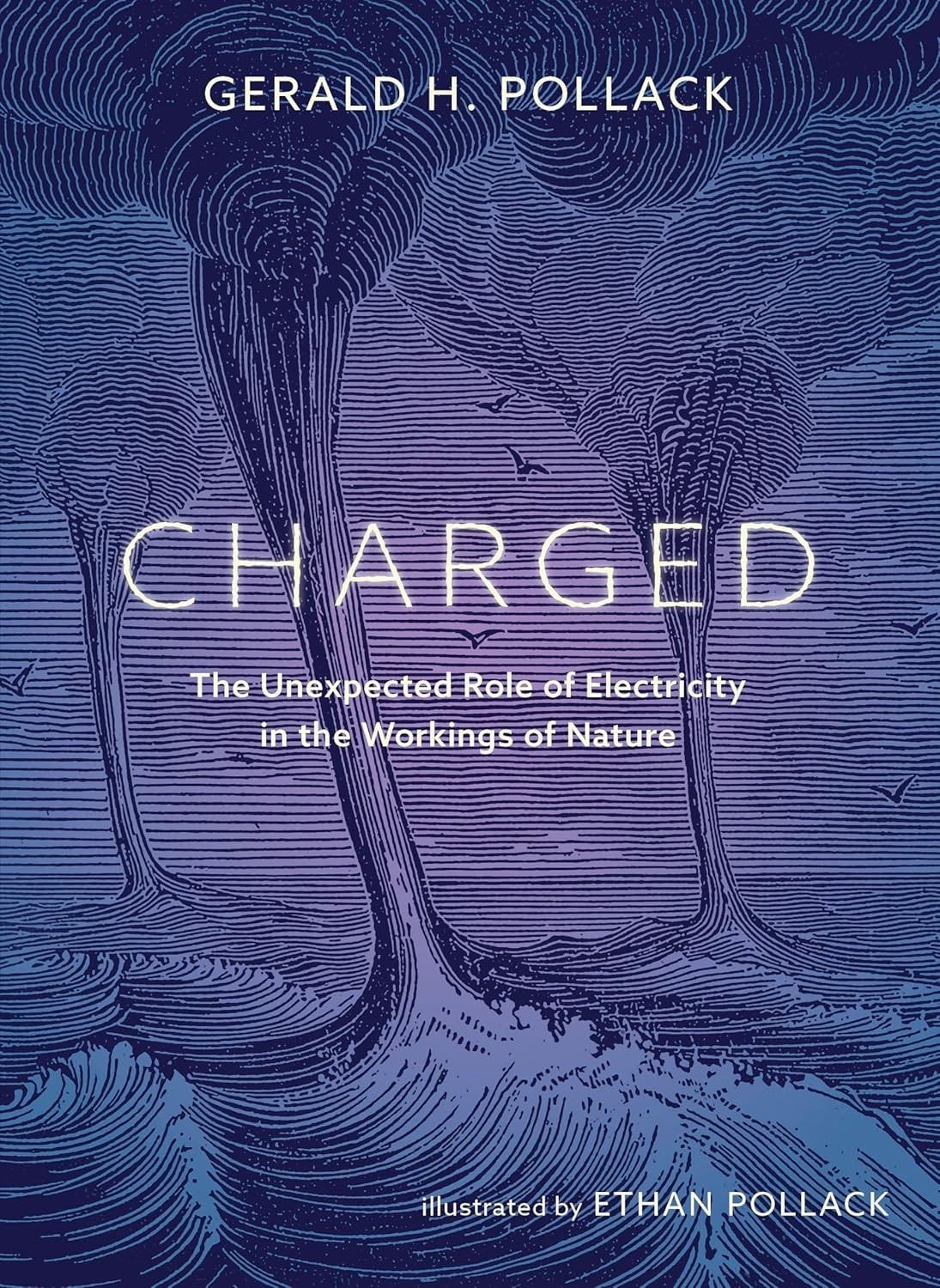
The last chapter of Charged expands on what I’ve interviewed him about in a previous year–I want to know why a revolution in the way we source electric power hasn’t happened.
Our world has seen revolutionary changes in our communications, transportation and other industries.
But most of the electric power generated still comes from messy fuel-burning. The most liberating revolution was stifled.
Sticking to mainstream is easier than pioneering.
Being a pioneer in more than one area of science, Dr. Pollack encountered a type of opposition mirrored in other fields, including energy.
Early in his career, he watched established scientists cling to their theory as if adhering to a religion. Even after it’s disproven.
Eventually he noticed that evidence which contradicts the prevailing view of established the scientists is often ignored.
“It’s easier to go with mainstream views and get accolades from the leaders in a field than to challenge those views. Because those leaders have so much power…”
“That’s not how science should work.”
However, resisting breakthroughs is a common response.
Imagine leaders in physics being confronted with compelling evidence for a form of energy previously unknown. It may be exciting for the physicists, but also feel destabilizing and threatening to their self-interest.
“As a result, temptation exists to dismiss the challenger with a mere wave of the hand. We may even hear ‘pseudo-science’ or ‘crackpot science.’”
“What’s at stake is the very future of the world, for a world without scientific leaps is a stagnant world, susceptible to decline.” —Institute for Venture Science
Gatekeepers control public opinion and funding
Lone dissidents have been ignored by way of dismissals such as ‘everyone knows Dr. So-and-so is deluded; that’s impossible, don’t pay attention.’
Such casual dismissal “lends reassurance to members of the group under challenge; they can feel secure in their thinking.”
In the past, challengers of a scientific paradigm only needed to sway a small number of influential leaders. Today, success requires convincing large numbers who may be reluctant to change their views.
Yet, hasn’t science progressed substantially in this century?
Novel technologies arrive, but new basic knowledge is rare, Dr. Pollack pointed out. Game-changing breakthroughs as revolutionary as splitting the atom are not showing up.
The laser, the transistor and the Internet were based on revolutionary science—from more than 30 years ago.
Press releases about findings that promise to cure cancer or revolutionize energy often come from institutions that gain prestige by making an exciting announcement.
However, Pollack explained to me in a 2019 interview, often those laboratory’s scientists are only suggesting a possible application for a finding, but have not yet had that particular success.
Therefore his institute’s aim is “to restore science to the richly bountiful enterprise it was before the funding agencies began imposing top-down management and inviting mainstream scientists to judge their challengers.”
Current system is weighted against game-changers.
In past eras, breakthroughs were made by scientists who were free to explore wherever their curiosity and unexpected observations led.
Today, administrators decide which research areas are likely to be fruitful, then the researchers must show progress within their niche. They usually make incremental progress, which means moving forward on the same path in small steps.
“Mainstream scientific leaders are reluctant to consider ideas that threaten their own well-funded efforts, which invariably represent the status quo.”
They have no incentive to investigate an unknown that could overturn our thinking about something important.
The process of vetting (deciding whose work deserves funding) is weighted. When someone applies for a grant, its administrators appoint an established leader in that field to review applications.
Such gatekeepers are naturally inclined to support applicants whose views agree with their own. Grant applicants understand this, so they submit safe, incremental proposals.
The institute has a strategy.
Critical mass is the key—funding at least ten scientists or teams, in separate laboratories worldwide, who have expertise for a given line of research.
Each lab might use a different method to check the work on a given hypothesis and they would come to independent conclusions. (A hypothesis is a tentative explanation for an observation, phenomenon, or scientific problem that can be tested.)
Depending on their findings, the scientists will either abandon the hypothesis or take it seriously.
It would be difficult for the science establishment to avoid talking about a disruptive discovery if a dozen research groups with complementary expertise had validated the same potentially earth-shaking idea.
“Until that happens,” Dr. Pollack said, “even the most compelling of revolutionary ideas will languish in obscurity, as many now do.”
Institute continues.
Ethan Pollack tells me that Glenn Estrabillo, Acting Chair of the Institute for Venture Science, is assuming expanded leadership and management responsibility for the Institute for Venture Science.
“His stated goal is to continue on with the founding principle: to support high-risk, unconventional scientific inquiry capable of producing foundational, paradigm-shifting discoveries.”
I am praying for him and sending positive healing energy! Hope he gets back to full health soon! He's one of those scientist I'd love to have a chat with. I had the luxury and pleasure of knowing Dr.Paul Laviolette who kind of gave me some guidance and allowed me to join his Model G Group and science foundation called the Starburst Foundation. But he passed in 2022 but his work continues, the spark he put in more than one person's mind is catching fire to scorching collaboration and open science where a paradigm shift is near, the flood gates are going to open and wash the gatekeepers out of history and the future!
You might want to take a look at strikefoundation.earth and look at the work of Malcolm Bendall. In the engineering sense he has had a major breakthrough in processing the exhaust of burning hydrocarbons. His scalable device, which he is calling a Thunderstorm Generator is capable of cleaning the exhaust stream of hydrocarbon burning devices to bring it to a state nearly equivalent to atmospheric breathable air. The science behind this device is still a work in progress but an engineered device has been developed to the level of practical application.